
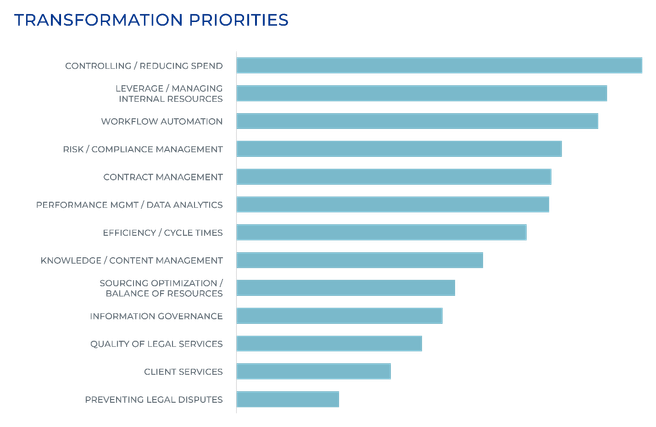
As the Legal Transformation wave progresses it also disperses. The term “transformation” once connoted comprehensive, multifaceted change in the operating model. Now, we see significant, hard-won change in more discrete aspects of operations. So in the Hyperion Legal Operations Benchmarking study of in-house legal executives conducted in Q1 2022, we teased out what strategic initiatives they are pursuing in priority order. The result is a ranking of the 2023 transformation initiatives across global legal departments, displayed in the chart below.
BURGEONING FOCUS ON WORKFLOW AUTOMATION TO GET RIGHT WORK INTO RIGHT HANDS
While controlling spending is a perennial priority, a reflection of persistent cost pressures, it is noteworthy that leveraging internal resources and automating workflows follow closely behind. Why? The short answer is that automation is not solely an efficiency play.
Legal departments are implementing low/no code applications, and to a more limited extent robotic process automation (RPA), not only to speed up processes but also to control internal work allocation and to generate valuable data.
Legal request intake and routing is the most common use case in corporate legal departments using workflow automation tools. Dynamic forms gather information from internal clients, triggering tailored workflows to get the request into the right hands in the right way. Frequently asked questions receive tailored responses, new matters or contracts are generated (perhaps an executable NDA on the spot), and a more nuanced request for advice is routed to the right person in the legal department. And that person may not be the most expensive human resource in the legal department – the tenured in-house counsel. Rather, a more junior lawyer or paraprofessional can respond, leaving the top lawyers – the overused “go to” counsel – free for more strategic legal advice.
One can appreciate the appeal of using the logic in the tool to decide who should act on each request, and to set it up as a task requiring action.
Structured visibility into the communications and actions taken relating to a legal service request is a boon to all stakeholders – but perhaps most especially to Legal when seeking to refute allegations of being the bottleneck.
What can’t be understated, however, is the importance of the data-driven insights these workflow automation tools yield.
EVER MORE DATA FOR OPTIMIZING OPERATIONAL PERFORMANCE
Over time, legal departments utilizing workflow automation tools generate valuable operational data. Not only do they show the volume and types of requests, and ideally improvement in response cycle times – but the legal department can also use trend data to pinpoint opportunities to improve service through additional legal resources, whether human or informational.
The challenge at hand is to ensure that the surging data is utilized effectively, as indicated by the growing focus on organizing data into performance management analytics and Key Performance Indicators (KPIs). As a sign of advancing operational maturity, many legal departments have moved on from the early-stage data-gathering efforts, becoming increasingly focused on choosing and methodically acting upon key performance indicators delivered via stakeholder-specific dashboards.
The key is to consider the priorities of the business. For example, if sales velocity is critical, contracting cycle time is a key metric, as are the underlying operational performance metrics to drive continuous improvement. Where there are pressures to reduce spending, it is important to utilize metrics to understand the drivers of cost and benchmarking to understand opportunities to adjust. For example, benchmarking data can be helpful to make the case for hiring to insource certain types of legal work, adjust staffing ratios over time, or change the mix of providers handling outsourced work.
In a strategic approach to legal operations, there is a focus on Objectives and Key Results (OKRs) in addition to Key Performance Indicators (KPIs). In other words, Legal Ops matures effectively when it is focused on a few clearly defined objectives and achieves demonstrable progress by tackling no more than two or three key initiatives each year.
